
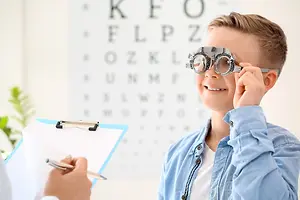
As the new academic year begins, parents across our community spend weeks checking off back-to-school lists—purchasing textbooks, updated clothes, and daily classroom supplies. However, one of the most critical foundations for academic performance is often left off the checklist: a complete clinical evaluation of your child's visual system. Our team at Visionary Eye Center is proud to introduce our newest eye doctor, who brings specialized expertise in pediatric vision care to our practice. With this expanded capacity, we are excited to offer local families greater access to thorough, technology-driven eye care tailored to developing students.
What Is the Difference Between a School Vision Screening and a Comprehensive Eye Exam?
A school vision screening is a brief check designed to spot obvious distance vision problems, whereas a comprehensive eye exam evaluates overall ocular health, eye alignment, focusing flexibility, and visual processing abilities.
School screenings play a basic public health role, but they are not designed to diagnose complex visual dysfunctions. Typically, a screening only checks visual acuity—how well a child can read letters on a wall chart 20 feet away. While distance vision is important, classroom learning requires a far wider array of visual skills, including:
- Eye Tracking: The ability to move both eyes smoothly across a printed page or digital screen without losing place.
- Eye Teaming (Binocularity): How efficiently both eyes point together to create a single, clear 3D image.
- Accommodation (Focusing Endurance): The ability to quickly shift focus from near objects, like a desk notebook, to distant objects, like the classroom board, without fatigue.
- Ocular Surface & Structural Health: Evaluating the internal and external structures of the eye to ensure long-term health.
How Functional Vision Issues Impact Classroom Learning
Undetected functional vision problems make reading and studying unnecessarily exhausting, often causing children to struggle with comprehension, experience headaches, or lose focus during school tasks.
When a child's eyes do not work together effortlessly, the physical act of reading requires immense physical effort. A student might do fine in every subject except those requiring prolonged reading, leading parents and teachers to misinterpret the issue as a lack of interest or attention. When a child comes to us struggling to keep their place on a page, our first priority is determining whether a physical vision deficit is creating that friction.
Recognizing the Signs of Visual Strain in Students
Children rarely complain about vision trouble because they assume everyone sees the world exactly as they do. Parents should look out for behavioral cues such as:
- Squinting, tilting the head, or covering one eye while reading.
- Frequent eye rubbing or excessive blinking during homework.
- Holding books or digital devices unusually close to the face.
- Avoiding reading or fine motor activities altogether.
- Complaints of blurry text, double vision, or frequent afternoon headaches.
Our Advanced "Detect and Treat" Approach to Pediatric Eye Care
Our clinical approach prioritizes diagnostic depth and technology-forward solutions to detect subtle visual issues before they hinder your child's academic confidence or visual development.
At Visionary Eye Center, we combine comprehensive primary eye care with specialized pediatric evaluations. Using state-of-the-art diagnostic instruments, our doctors assess total eye health and binocular function in a comfortable, child-friendly environment. Beyond identifying basic prescription needs, our practice offers proactive myopia management therapies to slow the progression of nearsightedness as your child grows, protecting their long-term ocular health.
Schedule Your Child's Exam in Reno Today
Scheduling a clinical eye exam before academic demands peak ensures your student begins the school year with clear, comfortable, and reliable vision.
Do not wait for a poor report card or classroom struggle to reveal a vision issue. /appointment-request-form/ to book a comprehensive pediatric vision evaluation with our expert optometric team at Visionary Eye Center, or call us directly at (775) 587-3892. You can also get interactive driving directions to our clinic via https://www.google.com/maps/search/?api=1&query=Google&query_place_id=ChIJBzn6eVAVmYARSdkeOifEUo0.
Frequently Asked Questions About Pediatric Vision
At what age should a child have their first comprehensive eye exam?
- Children should receive their first eye assessment between 6 and 12 months of age, followed by a thorough check at age 3, and annual exams once they begin school to track developing vision skills.
Can my child pass a school vision screening and still need glasses?
- Yes. School screenings routinely miss focusing flexibility issues, farsightedness, mild astigmatism, and eye alignment problems that significantly impact reading and close work.
What is myopia management for children?
- Myopia management involves evidence-based clinical treatments, such as specialized contact lenses or prescription drops, that slow down how fast nearsightedness worsens in growing children.
How long does a pediatric eye exam take?
- A comprehensive pediatric eye evaluation typically takes between 45 and 60 minutes, allowing our doctors enough time to perform complete health checks and functional vision tests without rushing your child.